 7 ways to combat anxiety - Free ebook


23 Feb Counselling vs CBT: Understanding the difference
Deciding to get help with your mental health is a big step but once you start looking into it, you see a lot of terms. Counselling. CBT. Talking therapy. It can get confusing fast. Most people start comparing counselling vs CBT and still don’t know where to begin.
At Future Edge Therapy, we speak to people who feel stuck but are unsure which type of support makes sense for them. There is no single answer. People are different and what works for one person might not work for someone else. Still, understanding counselling vs CBT can make the choice feel a bit clearer.
What is the main difference between counselling vs cbt
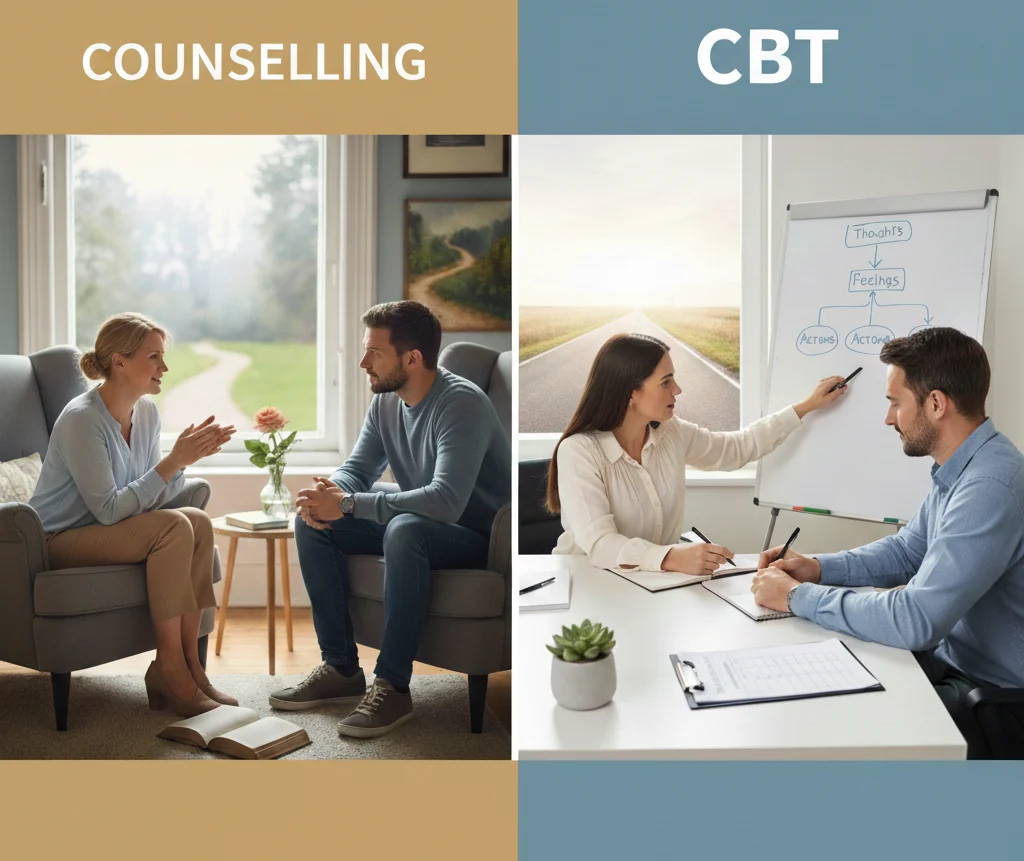
The easiest way to think about it is this. Counselling often looks at the why. CBT focuses more on the how right now.
Counselling gives you space to talk. You can bring what is on your mind that day. You might speak about the past. Or a breakup. Or grief. Or just how heavy things feel. The counsellor listens and helps you make sense of it. It moves at your pace. Some days you might go deep. Other days you might not.
CBT, which means Cognitive Behavioural Therapy, is more structured. It is based on the idea that thoughts, feelings, and actions all connect. If you shift one part, the others can change too. You might track your thoughts. You might try new ways to respond to stress. You usually have small tasks to try between sessions.
So when people ask about counselling vs CBT, it often comes down to depth versus structure. Both can help. Just in different ways.
How we look at counselling vs cbt at Future Edge Therapy
At Future Edge Therapy, we don’t see it as one or the other. The label matters less than what actually helps you move forward.
Some people do well with talking things through. Others feel stuck doing that alone. If trauma is part of the picture, just talking can feel like going in circles. That is something we see a lot.
We use approaches that are based on how the brain stores stress and memories. This includes EMDR, brainspotting, and IEMT. These can sit alongside elements of CBT or counselling. The aim is to help the brain process things that feel stuck.
We work with people across Milton Keynes, Northampton, and nearby areas. Some come in feeling overwhelmed. Some feel numb. Some just know something is not right but can’t explain it.
Which one might suit your situation
It depends on what is going on in your life right now and also on how you like to work.
Counselling can help if you need a place to talk and be heard. If you are dealing with loss, stress, or past experiences that still affect you. It gives you time to understand your patterns and reactions.
CBT can help if you are dealing with something more specific. Things like phobias, OCD, panic and anxiety that stops you doing daily tasks. It gives you tools you can use when things start to spiral.
Here is a simple way to look at counselling vs CBT.
Choose counselling if you want to explore the past. If you need space to process feelings. If you want support while going through a tough time.
Choose CBT if you want practical steps. If you like structure. If you want to focus on changing certain habits or thought patterns.
At Future Edge Therapy, we often use a mix. You might start with practical work to calm anxiety. Then later look more at the deeper stuff once you feel steadier. It depends on where you are starting from.
Why the approach matters more than the title
People often get stuck on the terms. Counsellor. CBT therapist. Trauma therapist. But the method alone is not the whole story.
What really matters is trust. If you don’t feel safe talking, it is hard to open up. And if you can’t open up, progress can feel slow.
We try to keep things simple and honest at Future Edge Therapy. No pressure. No overcomplicated language. Just looking at what is going on for you and what might help.
We offer a free 20 minute consultation. It is a chance to talk about what you are dealing with. We can then look at whether counselling, CBT style work, or trauma focused therapy might suit you better.
You don’t need to have the answers before you start. Most people don’t. They just know they are tired of feeling the way they do. And that is a good enough place to begin.